In abrasive service, the purchase price of a horizontal slurry pump is only part of the decision. The material selected for its impeller, liners, and other wetted wear parts can affect maintenance intervals, power consumption, replacement work, and the cost of an unexpected shutdown. Two pumps with similar connections and flow ratings may behave very differently when exposed to the same solids.
For many industrial buyers, the key question is whether a rubber-lined or hard-metal pump will deliver better service life at the intended duty. The answer depends on particle size and shape, solids loading, slurry chemistry, operating temperature, pump speed, and how closely the pump operates to its design point. Neither material is universally superior.
Rubber-Lined vs. Hard-Metal: Which Should You Choose?
Rubber-lined horizontal slurry pumps are often a strong choice for fine, relatively smooth abrasive particles when the elastomer is chemically and thermally compatible with the fluid. Hard-metal configurations—commonly using high-chrome white iron for wet-end components—are frequently favored where coarse or sharp solids, higher temperatures, or more demanding impact and hydraulic conditions could damage a rubber surface. Material selection must be based on the complete slurry and duty, not an average particle-size figure alone.
| Decision factor | Rubber-lined / elastomer | Hard-metal / high-chrome |
|---|---|---|
| Fine, rounded solids | Often favorable when chemistry and speed fit | Viable; may not provide the lowest wear cost |
| Coarse, sharp solids | Cutting and tearing risk rises | Often preferred; verify alloy toughness |
| Higher temperatures | Limited by the exact elastomer grade | Often more temperature tolerant |
| Corrosive fluid | Can isolate the casing if compatible | Requires alloy-specific corrosion review |
| Repair / replacement | Inspect for cuts, swelling, debonding | Inspect for erosion, grooving, cracking |
| Selection basis | Validated elastomer, hydraulic duty, solids | Validated alloy, hydraulic duty, solids |
A useful starting rule is to evaluate the most damaging particles in the stream, not simply the average. Even a small proportion of oversize stone, tramp metal, or angular fragments may change the appropriate liner choice. Pump makers should also confirm the selected impeller and liner combination is approved for the duty.
| NEXT STEP
Compare configurations on the DAE Pumps H-Series horizontal flooded suction pump page, then request an application-specific material recommendation. |

How Rubber and Hard-Metal Wear Parts Resist Abrasion
In a centrifugal slurry pump, rotating impeller vanes add energy to the liquid-solids mixture. Particles repeatedly contact the impeller passages, casing or volute liner, and inlet-side wear surfaces. Some impacts are nearly normal to the surface; others scrape along it. Wear depends on impact angle, relative velocity, particle hardness, concentration, and the material being struck.
Rubber and Elastomer Liners
Rubber resists certain forms of particle erosion by deforming under impact and recovering afterward. That behavior can make properly selected elastomers effective with fine and relatively rounded particles. Elastomer selection also offers chemical-resistance options, but natural rubber, synthetic rubbers, and polyurethane are not interchangeable materials; each has its own temperature, chemical, and abrasion limits.
Rubber can be damaged by cutting, tearing, swelling, hardening, or a loss of adhesion, depending on construction. Oversize debris and sharp particles are particular concerns. A rubber liner that works well for fine tailings may be unsuitable for another system carrying irregular gravel or occasional tramp material.
High-Chrome Iron and Other Hard-Metal Wear Parts
High-chrome white iron uses a hard, abrasion-resistant microstructure to combat wear from gritty solids. Hard-metal impellers and liners are common in demanding slurry duties, including many mineral-processing and sand applications. However, high hardness does not make every alloy immune to fracture, corrosion, or erosive wear. The selected grade must balance abrasion resistance, corrosion performance, and impact toughness.
A metal configuration can be suitable for a broad range of particle sizes, but it is still possible to wear a hard-metal impeller rapidly by running at excessive velocity, far from the best efficiency point, or with a mismatch between the fluid and alloy.
What About Polyurethane and Mixed-Material Designs?
Polyurethane and other engineered elastomers may offer advantages in specific fine-particle or sliding-abrasion duties. Some slurry-pump designs also use different materials in different wetted components. That does not mean a buyer can freely interchange any rubber liner, metal impeller, throatbush, or casing part. Fit, hydraulic geometry, speed limits, and manufacturer approvals must be checked before specifying a mixed-material arrangement.
Seven Factors That Determine the Right Liner Material
1. Particle Size Distribution and Maximum Solids
A solids report should include the full distribution—such as D10, D50, and D90—along with the largest credible particle or foreign object. A pump’s published maximum solids passage describes hydraulic clearance; it does not automatically establish a safe abrasive particle size for a particular rubber compound. Screens, cyclones, and upstream process changes can alter what reaches the impeller.
2. Particle Shape and Mineral Hardness
Rounded silica sand and sharp crushed rock do not produce identical wear patterns. Angular particles can cut elastomers, while very hard minerals can aggressively abrade hard-metal components. Identify the dominant mineral, likely hardness, sharp edges, and whether tramp material is present.
3. Solids Concentration, Density, and Viscosity
A slurry with more suspended solids creates more opportunities for particle contact and can change hydraulic losses and operating power. Solids percentage should be identified as weight or volume; the two are not interchangeable. Specific gravity and expected viscosity are also important for pump selection and motor sizing.
4. Slurry Chemistry, Temperature, and Process Variability
Measure pH and identify salts, hydrocarbons, solvents, and other chemicals rather than relying on pH alone. Some elastomers perform well against a particular corrosive fluid but fail when exposed to oil or elevated heat. High-chrome alloys can also suffer chemical attack under unfavorable conditions. Peak operating temperature, cleaning chemicals, and temporary process excursions belong in the specification.
5. Pump Speed, Head, and Operating Point
Pump operating speed influences the relative velocity of particles striking wetted surfaces. Higher internal velocities may accelerate erosion. The pump should be reviewed against its actual system curve, required head, and expected operating range—not just peak flow. Chronic operation far from the best efficiency point can increase recirculation, vibration, and wear.
6. Suction Conditions and Air Entrapment
Flooded suction helps keep the pump supplied with liquid, but poor suction geometry, inadequate net positive suction head available (NPSHa), air ingress, or unstable feed conditions can still cause cavitation and performance problems. These conditions may be mistaken for material failure because they can also damage impellers and reduce flow.
7. Maintenance Access, Spares, and Duty Cycle
For a remote mine or a plant that runs around the clock, the cost of an emergency shutdown may outweigh a modest difference in parts cost. Before selecting a liner, ask how quickly the wet end can be inspected, which components are stocked, whether repairs can be scheduled during planned outages, and how many operating hours or tons each component is expected to see.
Which Horizontal Slurry Pump Parts Wear Out First?
The highest-wear parts are usually those exposed directly to the solids-laden flow. Their exact names vary by pump construction, so equipment drawings and parts lists should be used when ordering replacements.
| Component | Common damage / warning signs | Maintenance response |
|---|---|---|
| Impeller | Leading-edge erosion, worn vanes, imbalance, falling performance | Inspect geometry, wear and balance; replace when limits are reached |
| Volute / casing liner | Loss of thickness, grooves, localized erosion, rubber cuts | Map wear zones and compare with allowable limits |
| Throatbush / suction liner (where fitted) | Widening clearance, inlet erosion, loss of efficiency | Check and adjust approved clearances; replace worn parts |
| Frame-side liner / wear plate | Recirculation erosion and reduced thickness | Inspect during planned wet-end service |
| Shaft seal and sleeve | Leakage, flush problems, scoring and contamination | Verify seal/packing condition and support utilities |
| Bearings / drive | Vibration, heat, contaminated lubricant, misalignment | Trend condition and service to manufacturer schedule |
An impeller and liner should not be evaluated independently from the pump hydraulics. As clearances increase, internal recirculation can rise and useful efficiency may fall. Depending on design, an adjustment mechanism may restore some performance between major wear-part replacements. Always use the specific OEM clearance and adjustment procedure.
Rubber-Lined vs. Hard-Metal Slurry Pump Maintenance
Both constructions require scheduled inspection. The difference is what the maintenance team looks for and how deterioration progresses. Rubber may show cutting, tearing, blistering, swelling, or localized loss of material. Metal parts may display grooving, thinning, pitting, cracking, or concentrated erosion at impact and recirculation zones. Neither inspection method should be reduced to a calendar-only replacement schedule.
Inspect the Wet End and Record the Wear Pattern
Record the pump tag, service hours, material handled, liner and impeller part numbers, photographs, and measured remaining thickness or clearance where practical. Repeated patterns can reveal whether the cause is unsuitable material, excessive speed, solids segregation, operating away from the duty point, or a change upstream. Comparing successive inspections is usually more useful than guessing a universal liner-life figure.
Monitor Operating Symptoms Before Failure
| Observed change | Potential causes worth investigating |
|---|---|
| Lower flow or discharge head | Worn impeller/liner, increased recirculation, suction restriction, lower speed |
| Rising vibration | Impeller imbalance, solids buildup, bearing or alignment issues, cavitation |
| Higher power draw | Changed slurry density, operating point, mechanical resistance |
| Seal leakage or contaminated lubricant | Seal wear, incorrect flush support, shaft sleeve/bearing issue |
| Unexpectedly rapid wear | New solids distribution, angular contaminants, higher velocity, incompatible material |
Maintain Clearances, Seals, Bearings, and Drive Components
Inspection should include impeller-to-liner clearance where adjustable, mechanical seals or packing, lubricant condition, bearing temperature, belt condition if fitted, alignment, and the seal-water system if applicable. Do not make an impeller clearance adjustment by applying a generic setting from another pump family. The approved clearance, shutdown isolation, lockout/tagout, and recommissioning procedures are specific to the model.
For predictive maintenance, establish baselines for vibration, temperatures, flow, discharge pressure, motor current, slurry density, and running hours. Trend changes against operating conditions so an increase caused by density is not automatically interpreted as bearing damage. Plan replacement once measured deterioration approaches documented limits, before a failure disrupts production.

Which Material Has the Lower Total Cost of Ownership?
A rubber liner may cost less to replace in one application and wear out faster in another. Likewise, a high-chrome component may carry a higher initial cost yet deliver a lower cost per operating hour—or the opposite, depending on the slurry. A fair comparison holds the operating duty constant and accounts for parts, service work, unplanned downtime, and changes in efficiency.
A practical starting measure is total period cost divided by productive operating hours. For production-driven operations, cost per ton of dry solids moved may be even more relevant. Include spare-parts inventory and replacement lead time as well as energy and labor costs.
| LIFECYCLE-COST CALCULATION
Cost per productive hour = (wear parts + planned service labor + unplanned downtime cost + energy + other directly attributable costs) ÷ productive operating hours. Record the assumptions and compare candidate configurations over the same production period. |
For example, a lower-priced liner is not the lower-cost choice if it forces an extra shutdown during a critical production run. Conversely, a heavy metal option may offer no economic advantage if an appropriate elastomer already provides satisfactory life at the duty. Avoid vendor claims about a fixed percentage increase in life unless backed by comparable service data.
Rubber or Hard Metal for Mining, Sand, Tailings, and Industrial Slurries?
| Application | Initial material evaluation | Important qualifier |
|---|---|---|
| Fine mineral tailings | Rubber or suitable alloy | Validate oversize solids, chemistry, speed |
| Coarse crushed ore / mill discharge | Hard-metal frequently considered | Impact toughness and pump design matter |
| Sand and aggregate transfer | Either; based on gradation | Sand angularity and gravel/tramp material matter |
| Fine abrasive process slurry | Rubber often merits evaluation | Check temperature, oils, chemicals |
| Hot or chemically aggressive slurry | Material-by-material engineering review | Check exact alloy/elastomer compatibility |
| Variable or unknown feed | Conservative review and sampling | Base selection on worst credible process duty |
Treat this table as a screening tool, not a procurement specification. Mining and industrial process conditions vary within the same facility. An application that appears suitable for rubber during normal operation can become damaging after a process change that introduces larger fragments or higher temperatures.
Can Rubber and Hard-Metal Wear Parts Be Combined?
Depending on the pump’s approved design, different wetted components may use different materials. The objective is to address the distinct damage mechanisms at the impeller, inlet, and casing rather than specifying one material everywhere. But combinations must be supported by the manufacturer: geometry, component fit, balance, speed, temperature, and hydraulic performance can all change. Do not replace an engineered rubber impeller with a metal impeller—or vice versa—without a verified compatible configuration.
DAE Pumps H-Series: Comparing Metal and Rubber-Lined Horizontal Pumps
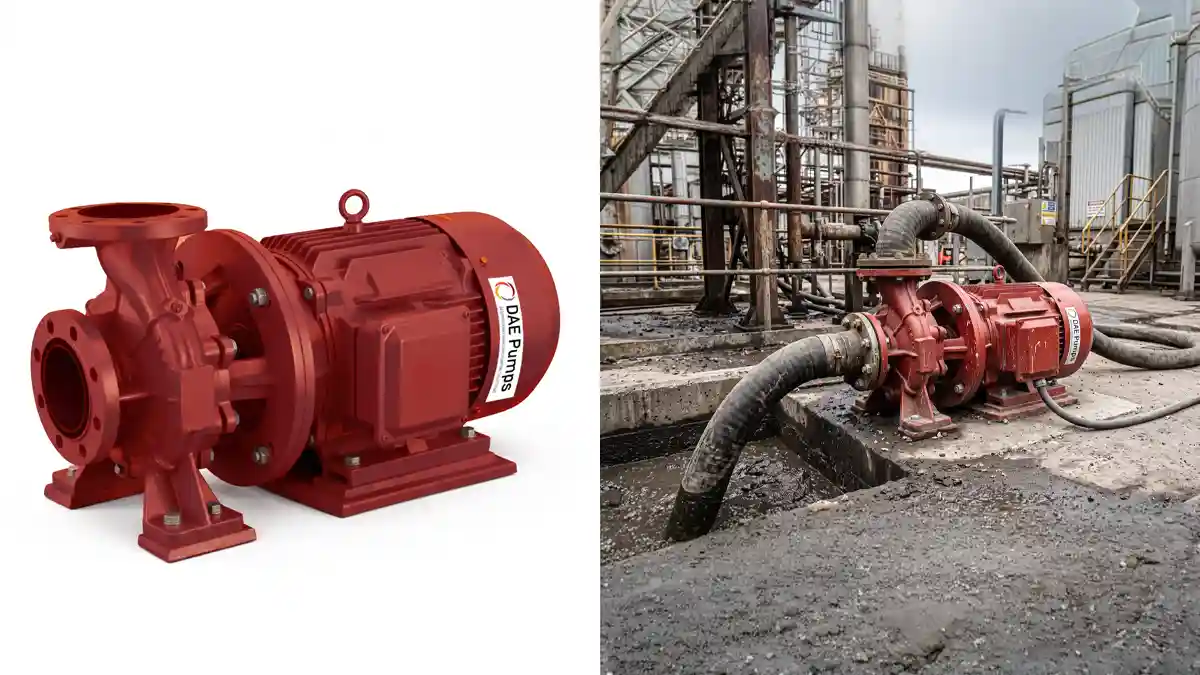
DAE Pumps offers H-Series horizontal flooded suction centrifugal pumps in metal-liner and rubber-liner configurations, along with high-head metal variants for selected sizes. These dry-mounted pumps are intended for applications with adequate liquid supply at the suction and are used across industrial, mining, and slurry-transfer duties. The correct model is selected from the actual duty point, available suction conditions, fluid characteristics, and acceptable solids size.
As an example, the published H-Series product listing identifies the H640 metal-liner model and H640R rubber-liner model with the same nominal 6-inch suction and 4-inch discharge connections. Their published flow and solids-passage values differ; these are model-level specifications, not evidence that replacing one liner material alone causes the change.
| Published H-Series listing | H640 — metal liner | H640R — rubber liner |
|---|---|---|
| Inlet / outlet | 6 in / 4 in | 6 in / 4 in |
| Maximum listed flow | Up to 2,200 GPM | Up to 1,850 GPM |
| Maximum listed solids passage | Up to 1.7 in | Up to 1.3 in |
| Material construction | Metal-liner configuration | Rubber-liner configuration |
These published limits are model descriptors, not guaranteed operating points for dense slurry. Pump performance and power must be reviewed against the actual slurry specific gravity, total dynamic head, suction conditions, and the correct performance curve. DAE's H-Series model listings provide a starting point; the slurry pump sizing guide covers the wider hydraulic selection process.
| COMMERCIAL CTA
Request a DAE Pumps recommendation using your particle-size distribution, slurry density, temperature, target flow and head, hours of operation, and current wear or maintenance issues. |
What to Provide Before Selecting or Replacing Wear Parts
A well-defined application saves time during technical review and helps avoid a purchase based only on nominal port size or maximum GPM. Assemble the following details before requesting a recommendation:
- Liquid chemistry, pH, temperature range, and any hydrocarbons or cleaning agents.
- Particle size distribution, maximum expected solids, shape, hardness, and tramp-material exposure.
- Solids percentage by weight or volume, slurry specific gravity, and viscosity if known.
- Required flow, total dynamic head, pipeline length and diameter, and discharge elevation.
- Available suction conditions, tank levels, suction layout, and NPSHa estimate.
- Operating schedule, current pump speed and power, expected wear-part change interval.
- Current pump model, impeller/liner materials, photos of worn parts, and failure history.
The output should be a recommendation for the complete wet-end configuration and hydraulic operating range—not a material label in isolation. If a plant is switching from rubber to metal or changing the slurry process, ask the pump supplier to verify the design and performance implications.
Frequently Asked Questions
Are rubber-lined slurry pumps better than metal-lined pumps?
Not in every application. Rubber can perform exceptionally well in properly matched fine-slurry service, while hard-metal parts often suit coarse, sharp, or demanding high-energy conditions. The best option is the one that meets the hydraulic duty, survives the actual solids and chemistry, and delivers the lowest practical operating cost.
What is the best material for an abrasive slurry pump?
Common choices include high-chrome iron and selected elastomers. The proper material depends on particle size distribution, particle shape and hardness, chemical compatibility, temperature, and impeller speed. A vendor should review representative slurry data and the full pump operating point before recommending a specific grade.
When should a high-chrome slurry pump be considered?
High-chrome iron deserves consideration where the slurry contains coarse or sharp abrasive solids or conditions that may cut rubber liners. However, corrosion, impact toughness, and operating speed still need review. High hardness alone is not a guarantee of longer service life.
What causes slurry pump impellers to wear out?
Impellers wear through repeated contact with solids, especially at high local velocities or unfavorable impact angles. Cavitation, recirculation, abrasive particle hardness, and operating far from the intended duty point can accelerate damage. Regular inspection should connect the observed wear pattern with slurry and operating conditions.
How often should a horizontal slurry pump be inspected?
Use the manufacturer's maintenance instructions and the severity of the application to establish inspection frequencies. Operational checks for unusual vibration, leakage, bearing heat, and changing performance may be frequent, while internal inspections are generally coordinated with planned shutdowns and condition trends. There is no single safe inspection interval for every slurry.
What are the signs of worn slurry pump liners?
Warning signs include reduced performance, increased internal clearance, unexpected vibration, and visible damage during inspection. Rubber liners may have cuts, swelling, or tears; metal liners can show deep grooves, thinning, or cracking. Performance changes can also have other causes, so confirm the diagnosis with measurements and component inspection.
Can rubber liners and metal impellers be used together?
Some pump designs offer approved mixed-material configurations, but components are not automatically interchangeable. A combination must be checked for manufacturer-approved geometry, fit, balance, speed, and compatibility with the slurry. Never infer that a field swap is acceptable from the material names alone.
Which slurry pump material has lower maintenance costs?
Compare the total cost over a representative production period. Include replacement parts, planned labor, downtime, energy, emergency repairs, and spare-parts lead time. A material with a higher purchase price can still cost less per productive hour when it reduces disruptions; another may be more economical in mild fine-slurry service.

Choose Wear Parts Around the Slurry, Not Just the Pump Size
Horizontal slurry pumps are built to withstand abrasive service, but liner and impeller selection still determines how that wear is managed. A complete decision compares solids properties, chemical and temperature limits, pump hydraulics, accessible maintenance, and cost per productive hour. For operators comparing rubber-lined and high-chrome wear parts, the most valuable next step is an application review using actual slurry and operating data.
Review the DAE Pumps H-Series horizontal pump range or request a pump and wear-part recommendation. DAE can evaluate the required flow, head, solids handling, and approved wetted-end options for your application.