BELOW THE SURFACE
Industrial
Submersible Pumps
Electric and hydraulic submersible pumps for drainage, sludge, abrasive slurry, and sand. Find a heavy-duty submersible pump for your material and operating duty.
Drainage · Sludge · Slurry · Sand
PRODUCT RANGES
Submersible Pump Ranges
Browse the electric and hydraulic ranges, then review the model curve, solids capacity, and installation requirements.

ELECTRIC DRIVE
Drainage & dewatering
Remove clean and dirty water from pits, sumps, excavations, and construction sites. Start here when water removal is the main task.
Includes the Clifton series

ELECTRIC DRIVE
Submersible slurry pumps
Handle abrasive mixtures of water and solids in mining, quarrying, and settling-pond work. Compare the Tampa and Lansing ranges.

ELECTRIC DRIVE
Payload sand & slurry
Explore an electric dredge-pump configuration for sand and solids transfer, with deployment options for excavator or cable-supported work.

ELECTRIC DRIVE
Clifton (series of Drainage & Dewatering)
Explore the Clifton electric drainage range for site dewatering and water transfer. Compare the individual models against your required duty.

HYDRAULIC DRIVE
La Paz submersible
Compare compact hydraulic submersible options for water, sludge, and slurry duties where a hydraulic power source fits the installation.

HYDRAULIC DRIVE
Hauler sand & slurry
Explore hydraulic sand and slurry pumping for dredging and material recovery, with excavator or cable deployment to suit the work area.
ELECTRIC DRIVE
Remove clean and dirty water from pits, sumps, excavations, and construction sites. Start here when water removal is the main task.
Includes the Clifton series
ELECTRIC DRIVE
Handle abrasive mixtures of water and solids in mining, quarrying, and settling-pond work. Compare the Tampa and Lansing ranges.
ELECTRIC DRIVE
Explore an electric dredge-pump configuration for sand and solids transfer, with deployment options for excavator or cable-supported work.
ELECTRIC DRIVE
Explore the Clifton electric drainage range for site dewatering and water transfer. Compare the individual models against your required duty.
HYDRAULIC DRIVE
Compare compact hydraulic submersible options for water, sludge, and slurry duties where a hydraulic power source fits the installation.
HYDRAULIC DRIVE
Explore hydraulic sand and slurry pumping for dredging and material recovery, with excavator or cable deployment to suit the work area.
APPLICATIONS
Submersible Pump Applications
Use the liquid, solids, and site conditions to narrow the range. For chemical, oil, or saltwater service, confirm material and seal compatibility for the selected model.
01
Dewatering and Drainage
- Construction and excavation dewatering
- Groundwater, raw water, and sumps
- Mine and quarry water removal
- Flooded work areas and drainage
02
Slurry, Sand and Sediment Recovery
- Mining slurry and mineral processing
- Sand, gravel, and abrasive sediment
- Pond cleaning and dredging
- Barge offloading and material transfer
03
Industrial Sludge and Tank Cleanouts
- Wastewater sludge and tank cleanout
- Paper and pulp process mixtures
- Fly ash and coal ash handling
- Process duties requiring material review
01 / THE BASICS
How a submersible pump works
A submersible pump operates in the liquid it moves. The impeller transfers energy to the liquid, which leaves the pump through the discharge connection.
Because the pump is positioned below the liquid surface, the installation avoids a long suction-lift arrangement. Performance still depends on the pump curve, operating level, discharge piping, and the properties of the material being moved.
The same operating principle supports different duties. Submersible drainage pumps focus on water removal; submersible sludge pumps, slurry pumps, and sand pumps use different passages and wear components for solids-bearing mixtures.
Motor & seals
The drive turns the impeller; the sealing arrangement protects the motor from the pumped liquid.
Impeller & casing
These components move the liquid and develop the pressure needed to send it into the discharge line.
Inlet & strainer
The inlet arrangement is selected for the water and solids the pump must handle.
Agitator, where fitted
A slurry-pump agitator helps mobilize settled material near the intake.
DAE Pumps overview: electric and hydraulic submersible pumps for slurry, sand, and dewatering.
02 / MATERIAL FIT
Match the Pump to the Material
The names sludge and slurry are useful starting points, but the actual mixture determines the pump selection.
Record the largest solids, approximate concentration, abrasiveness, temperature, and any chemical exposure. Ask how those conditions change during the job—for example, when a pond starts with water above a settled layer of sand or mud.
Drainage: water removal first
Submersible drainage pumps suit groundwater, raw water, sumps, and construction dewatering. When selecting a heavy-duty submersible water pump, check the strainer and solids-passage limits; a drainage pump should not be chosen for dense, abrasive slurry based on discharge size alone.
Sludge: thicker mixtures and cleanout
A submersible sludge pump can move mud, settled waste, or other thicker mixtures. When selecting a submersible mud pump for desludging or desilting, review the consistency, largest particles, and solids concentration to confirm the pump and inlet arrangement.
Slurry: abrasive solids in suspension
For quarrying, mining, settling ponds, and material transfer, check the wear materials and clear passage through the pump. Abrasive service can call for high-chrome wear parts, an agitator, and a maintenance plan suited to the actual duty.
Sand: plan for abrasive wear
A submersible sand pump needs a configuration suited to abrasive sand and sediment. Sand wears the impeller, casing, and discharge system, so plan regular inspection and replacement of worn parts. Include the hose and piping when reviewing wear exposure.
03 / POWER & DEPLOYMENT
Electric vs Hydraulic Submersible Pumps
DAE offers electric and hydraulic submersible ranges. Choose the drive around the available power, access, operating duty, and maintenance arrangements.
Electric drive
A practical starting point when the site can supply the required electrical power.
- Confirm voltage, phase, frequency, and available capacity.
- Plan the cable run, controls, starting method, and level protection.
- Compare drainage, slurry, Payload, and Clifton options.
Hydraulic drive
An option when a compatible hydraulic power source suits the deployment.
- Match required hydraulic flow and pressure to the pump.
- Include hose length, connections, and power-unit requirements.
- Compare La Paz and Hauler configurations.
04 / SELECTION CHECKLIST
How to Size a Submersible Pump
The right pump is the one that meets the required flow and head while handling the material and fitting the installation.
Provide a target flow rate and the total system head, including the elevation change and losses through the discharge line. Include hose or pipe diameter, length, fittings, and the receiving location.
- Material: largest solids, concentration, abrasiveness, and temperature.
- Duty: required flow, lift, discharge distance, and operating hours.
- Site: working depth, minimum liquid level, access, and recovery method.
- Power: electrical supply or available hydraulic flow and pressure.
Request a pump-curve review for the complete duty, especially when comparing high-head submersible pumps. A discharge size or maximum flow figure alone does not describe performance at your operating point.

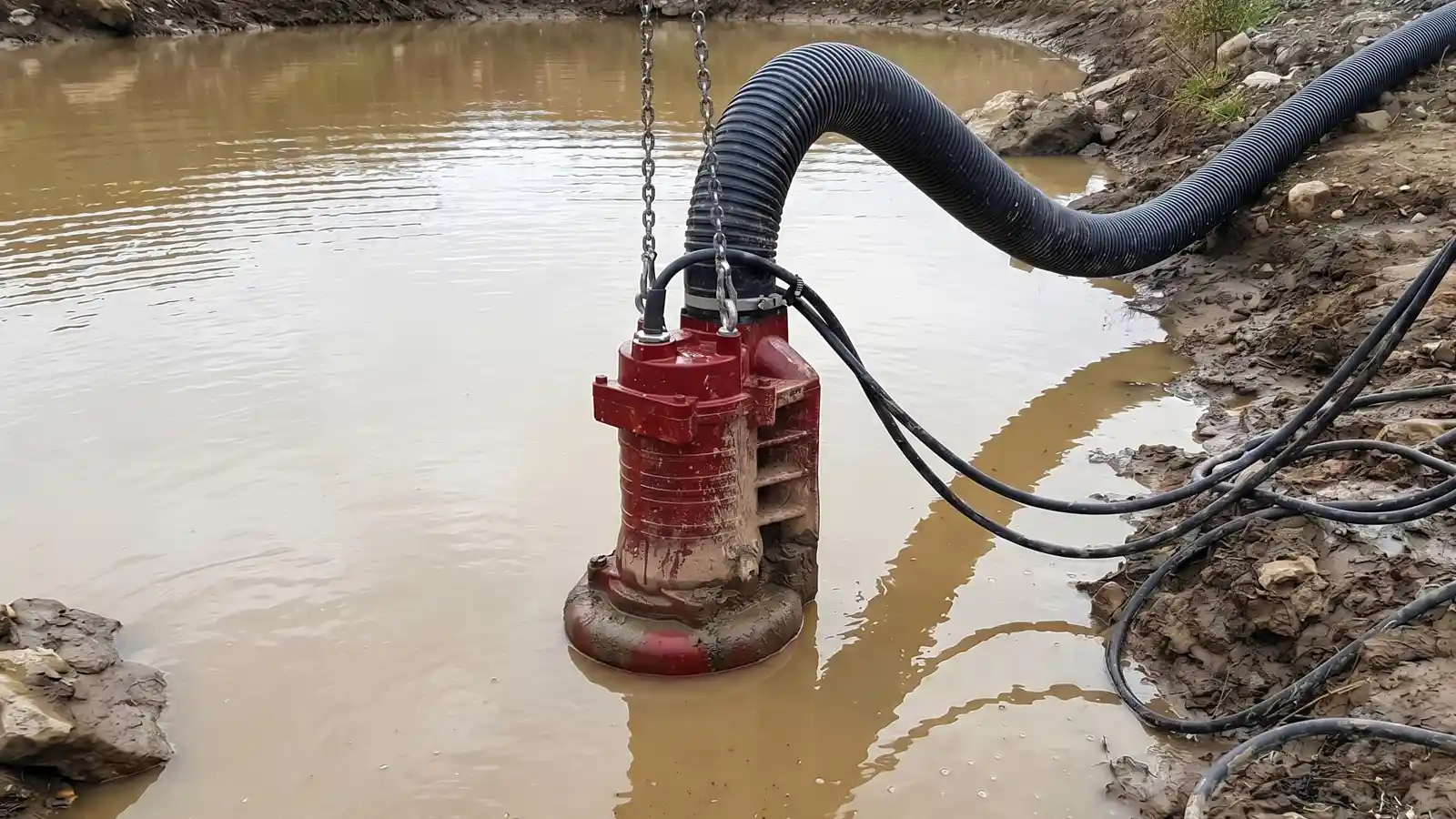
Submersible slurry pump with a black discharge pipe, operating in a muddy dewatering pit.
05 / INSTALLATION & CARE
Installation and Maintenance
Build access, inspection, and spare-part needs into the installation before the pump goes into service.
Installation and startup
Follow the selected model’s installation and startup instructions. Plan a stable operating position, adequate submergence, the discharge connection, and access for service. Confirm that the power supply and controls match the pump before operation.
Routine inspection and wear parts
Set the inspection interval around the material and operating hours. Check the inlet, impeller, casing, seals, cable or hydraulic hoses, and discharge system for wear or damage. Replace worn components using the model’s maintenance instructions.
Low flow, overheating, or repeated trips
A restricted inlet, obstructed discharge line, worn components, changed duty, or a power problem can affect performance. Isolate the power before inspection, follow the model’s troubleshooting procedure, and ask DAE for support when the cause is unclear.
Abrasive service makes wear-part planning especially important. Discuss the operating duty, expected inspection points, and recommended spares with DAE when selecting the pump.
SIZES & MODELS
Submersible Pump Sizes and Models
Use these model links as a starting point. Check the individual pump curve and solids capacity before choosing a size.
Swipe horizontally to compare the full table.
| Discharge | Explore models | Selection focus |
|---|---|---|
| 2-inch | Clifton: 237 | Compare the smallest drainage model against the required flow and head. |
| 3-inch | Tampa: 337 355 Lansing: 340 Clifton: 337 355 3110 La Paz: 3-inch Payload: 3-inch Hauler: 3-inch |
Compare compact electric and hydraulic options against the required flow, head, and solids passage. |
| 4-inch | Tampa: 437 455 475 4110 Lansing: 460 Clifton: 437 455 475 4110 4150 4220 La Paz: 4-inch Payload: 4-inch Hauler: 4-inch |
Review the different duty points within the same discharge size, and match the drive to the power available. |
| 6-inch | Tampa: 6110 6150 6150-L 6220 Lansing: 690 Clifton: 675 6110 6150 6220 6370 6450 Payload: 6-inch Hauler: 6-inch |
Compare flow-oriented and higher-head options for the complete discharge system. |
| 8-inch | Tampa: 8220 Lansing: 8150 8220 Clifton: 8220 8370 8450 Payload: 8-inch Hauler: 8-inch |
Review the larger-discharge models with the selected hose or piping arrangement. |
| 10-inch | Payload: 10-inch Hauler: 10-inch |
Explore larger sand and slurry configurations and confirm the model against the required flow and head. |
| 12-inch | Payload: 12-inch Hauler: 12-inch |
Compare high-volume electric and hydraulic options for large transfer and dredging duties. |
| 14-inch | Payload: 14-inch Hauler: 14-inch |
Compare high-volume electric and hydraulic options for large transfer and dredging duties. |
| 16-inch | Payload: 16-inch Hauler: 16-inch |
Review the largest-discharge configurations with the full pipeline and power arrangement. |
Models are grouped by discharge size. Each range has its own model configurations and operating limits. Check the individual pump curve and solids capacity before choosing a size.
COMPLETE THE SYSTEM
Submersible Pump Accessories
Plan the discharge route, power supply, and monitoring together. These accessories support a complete material-handling system.

Slurry hoses
Match the discharge connection, route, and wear requirements.

Flow meters
Track transfer flow as part of the pumping system.

Hose & pipe floats
Support floating pipeline sections and the site layout.

Hydraulic power units
Pair hydraulic pumps with the required power supply.
COMMON QUESTIONS
Submersible Pump FAQs
Clear up the operating details before comparing individual models.
Does a submersible pump need priming?
A pump operating with its inlet submerged generally avoids the separate suction-line priming required by a surface installation. Maintain the required liquid level and follow the selected model’s startup procedure.
Can a submersible pump run dry?
Do not assume every model can operate without liquid. Minimum submergence, cooling, and protection requirements depend on the pump. Check the model instructions and specify suitable level controls for the installation.
What is the difference between a sludge pump and a slurry pump?
Both handle mixtures of liquids and solids. The selection depends on the actual solids size, concentration, abrasiveness, and flow characteristics. Describe the material and operating duty so DAE can review the appropriate configuration.
Should I choose electric or hydraulic power?
Start with the power available on site and the deployment method. Electric models require the appropriate supply and controls; hydraulic models require a compatible source with the correct flow and pressure. Review both against the required pumping duty.
Does a larger outlet always mean more flow?
No. Flow depends on the model’s pump curve, system head, speed, and the material being moved. Different models with the same discharge size can have different operating characteristics.
What information should I send for pump selection?
Share the application, material, largest solids, target flow, discharge elevation and distance, hose or pipe size, available power, operating hours, and site access. Photos and an outline of the discharge route can also help.
FROM PROJECT DETAILS TO A WORKING PLAN
The right pump starts with your job.
Tell us what you need to move, where it needs to go, and what the site demands. We’ll help you identify the next step.
01
The material
Water, solids, or slurry
02
The duty
Target flow and total head
03
The site
Access, power, and route
A DIRECT LINE TO DAE
Let’s talk through the job.
Selection questions, project details, or a model you already have in mind.
Call our team
Email your project