


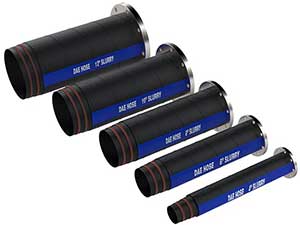

Dredge Hoses
Dredge hoses, also known as slurry hoses, provide the safe and efficient transferring of sludge, slurry, abrasive solids, and corrosive material. A common type is the suction hose, which is specifically designed for drawing up sediments and slurry in demanding environments. Suitable for use in dredging, mining, oil, construction, agriculture, sewage, wastewater, and chemical industries, these hoses are frequently used due to their durability and adaptability. DAE Pumps dredge hoses are the best on the market at handling the most abrasive slurry. They easily connect to the discharge end of dredge and slurry pumps with a snug fit. We make 4-inch, 6-inch, 8-inch, 10-inch, and 12-inch hoses at lengths of 10 meters (33 feet), with a total inventory available to meet large-scale project needs. These reliable hoses operate at pressures of up to 150 PSI and are flexible for high-pressure, high-strain applications.
DAE Pumps dredge hoses are reinforced with steel braided synthetic cord incorporating a steel wire helix. The inner rubber liner offers abrasion-resistant hose rubber of the highest quality, and the outer cover is developed with the most aging resistance and corrosion-resistant material. The bending angle working condition of the DAE Pumps slurry hoses is from 0°-45°, and the ideal working temperature is between -20°C to 50°C. The flange is a standard ANSI 150 PSI fixed flange. These hoses are engineered to maintain vacuum and full vacuum pressure without collapsing, ensuring durability and reliable performance in tough conditions.

Get Pricing
Dredge Hoses
Dredge Hose Specs
DAE Pumps hoses are made with an inner layer that is 8mm thick for long-lasting durability. These heavy-duty hoses are made with carbon steel and with a working pressure of 150 PSI. The Dredge hose sizes are determined by the inner diameter in inches. We carry standard 10-meter (33 foot) length hoses and can custom-build up to that length. Each hose is constructed with a specific number of plies or layers, with quality assurance performed in-house, ensuring strength and reliability for demanding applications.
Features:
- Highly Resistant Inner Rubber Compound
- Capable of Handling High Solids
- High Viscosity/Gravity Pumping
- High Abrasives Pumping
- Low pH & Chemical Pumping
- Designed to Prevent and Reduce Clogs
- Longer Lifespan & Minimal Downtime
| Product Name | SLURRY DISCHARGE HOSE |
|---|---|
| Technical Parameters | Tube: NR, BR, SBR Reinforcement: High tensile strength fabrics with helix steel wire Cover: NR, CRNo Negative Pressure |
| Safety Factor | 3:1 |
| Working Temperatures | 20℃ to 80℃ |
| Flange | Standard ANSI 150 PSI Fixed Flange |
| Inner Diameter | Outer Diameter | Thickness of Inner Layer | Working Pressure | Length | Weight | Flange ANSI 150 PSI |
|---|---|---|---|---|---|---|
| 4″ (102 mm) | 5″ (128 mm) | 5/16″ (8 mm) | 150 PSI | 33′ (10 m) | 199 lbs (90.3 kg) | Carbon Steel |
| 6″ (152 mm) | 7″ (182 mm) | 5/16″ (8 mm) | 150 PSI | 33′ (10 m) | 331 lbs (150.1 kg) | Carbon Steel |
| 8″ (203 mm) | 9.3″ (237 mm) | 5/16″ (8 mm) | 150 PSI | 33′ (10 m) | 485 lbs (220 kg) | Carbon Steel |
| 10″ (254 mm) | 11.3″ (288 mm) | 5/16″ (8 mm) | 150 PSI | 33′ (10 m) | 618 lbs (280.3 kg) | Carbon Steel |
| 12″ (300 mm) | 13.3″ (338 mm) | 5/16″ (8 mm) | 150 PSI | 33′ (10 m) | 850 lbs (385.5 kg) | Carbon Steel |
Standard ANSI 150 psi Flange Specification
| Normal Diameter | Number of Bolt Holes | Diameter of Bolt Holes | Flange Thickness | Outer Diameter of Flange |
|---|---|---|---|---|
| 4″ (102 mm) | 8 | 5/16″ (18 mm) | 0.89″ (22.5 mm) | 9″ (228 mm) |
| 6″ (152 mm) | 8 | 7/8″ (22 mm) | 0.94″ (24 mm) | 11″ (278 mm) |
| 8″ (203 mm) | 8 | 7/8″ (22 mm) | 1.15″ (29 mm) | 13.5″ (345 mm) |
| 10″ (254 mm) | 12 | 1″ (26mm) | 1.18″ (30mm) | 16″ (405mm) |
| 12″ (300 mm) | 12 | 1″ (26mm) | 1.26″ (32mm) | 19″ (485mm) |
Bend Radius
| Normal Diamete (in)r | Range |
|---|---|
| 4″ (102 mm) | 24.5″-40″ (620 mm – 1020 mm) |
| 6″ (152 mm) | 36″-60″ (920 mm – 1520 mm) |
| 8″ (203 mm) | 48″-80″ (1220 mm – 2030 mm) |
| 10″ (254 mm) | 60″-100″ (1530 mm – 2540 mm) |
| 12″ (300 mm) | 72″-120″ (1820 mm – 3040 mm) |
Introduction to Dredging
Dredging is a vital process used to excavate and remove sediments, sand, and other materials from the bottoms of rivers, lakes, harbors, and oceans. This operation is essential for maintaining navigable waterways, preventing shoreline erosion, and supporting a wide range of industrial, construction, and environmental projects. At the core of every successful dredging operation are dredge hoses—specialized hoses designed for the efficient transfer and handling of abrasive and heavy materials.
Dredge hoses come in several types, each engineered to meet specific application needs. Floating dredge hoses are designed to remain buoyant on the water’s surface, making them ideal for transferring materials over long distances without submerging. Suction hoses are used to draw up sediments and slurry from the dredge site, while discharge hoses handle the outflow of materials to designated locations. These hoses are manufactured using heavy-duty rubber compounds that offer exceptional wear resistance, flexibility, and durability, even under the harshest conditions. The rubber lining and outer layers are formulated to withstand constant exposure to sunlight, water, and abrasive materials like sand and gravel.
The production of dredge hoses involves careful selection of materials and precise engineering to ensure each hose meets the rigorous demands of the industry. Hose diameter and length are critical factors, with options ranging from 10 inches to 24 inches in diameter and lengths up to 50 feet or more, allowing for customization based on the specific requirements of each project. The right combination of diameter, length, and lining thickness ensures optimal material handling and transfer efficiency.
In addition to hoses, dredging operations rely on a range of supporting equipment, including couplings, flanges, and pumps. The type and quantity of these components are determined by the application, and a team of industry experts often collaborates to design solutions that meet the unique needs of each project. Whether transferring sand in a mining operation or clearing silt from a harbor, the flexibility and resistance of modern dredge hoses make them indispensable across a broad range of industries.
As demand for efficient dredging solutions grows, so does the need for innovative hose technologies that can handle higher volumes, greater wear, and more challenging environments. The price and availability of dredge hoses depend on factors such as type, size, length, and quantity, but with the right expertise and equipment, even the most complex dredging projects can be completed efficiently and cost-effectively. From mining and construction to environmental remediation, dredge hoses are designed to meet the evolving needs of the industry, ensuring reliable material transfer and long-lasting performance in every application.
Accessories
Get turnkey solutions that include dredge hoses, slurry flow meters, power units, tanks for the collection and storage of slurry, and more. These accessories, such as tanks, are designed to integrate seamlessly into the overall pumping process, ensuring efficient material handling and process optimization. Choose from multiple sizes of slurry hoses for the transferring of materials, wireless flow meters for measuring the flow rate in gallons per minute of liquid, and power units for operation. Parts are always in stock and available for immediate shipping to anywhere in the US and the world.
Maintenance and Repair
Regular maintenance is essential for ensuring the optimal performance and longevity of slurry pumps, including electric slurry pumps and submersible slurry pumps. In demanding applications such as mining, dredging, and construction, pumps are often exposed to high viscosity slurries, abrasive materials, and challenging conditions that can accelerate wear and increase the risk of clogging. To address these challenges, modern slurry pumps are constructed with wear resistant materials and specially designed impellers and wear parts, significantly reducing the frequency of repairs and minimizing downtime.
One of the standout features of today’s electric slurry pumps is their easy maintenance. Many models are engineered for quick and straightforward replacement of wear parts and seals, allowing operators to perform routine maintenance with minimal disruption to operation. This not only helps to keep operating costs and energy consumption in check, but also ensures that the pump continues to deliver efficient and reliable performance, even when handling tough materials like fly ash or sediment.
Regular inspection and verification of key pump components—such as the impeller, seals, and pressure systems—are crucial for identifying signs of wear before they develop into major issues. By adjusting the impeller and replacing worn parts as needed, operators can optimize the pump’s efficiency and extend its service life. This proactive approach to maintenance is especially important in industries where downtime can be costly and where the security and reliability of pumping systems are paramount.
In addition to in-house maintenance, many manufacturers offer specialized repair services, spare parts, and expert technical support to help operators maintain the quality and performance of their slurry pumps. When selecting a pump, it’s important to consider not only its suitability for your specific application, but also the maintenance requirements and support services available. By investing in high-quality, wear resistant pumps and adhering to a regular maintenance schedule, operators can reduce operating costs, minimize downtime, and ensure safe, efficient operation across a wide range of industries.
Ultimately, prioritizing maintenance and repair is key to maximizing the productivity and reliability of your slurry pumping systems. Regular verification and prompt response to any issues help maintain the security and efficiency of your operation, allowing you to meet the demands of even the most challenging pumping applications.

Slurry Hoses

Flow Meters

Hose & Pipe Floats

Hydraulic Power Units
Dredge Hose Applications
- Agricultural
- Chemical
- Construction
- Dewatering
- Dredging
- Mining
- Municipal
- Oil & Gas
- Paper & Pulp
- Sewage