


UFM1000 Doppler Ultrasonic Flow Meters
DAE Pumps UFM1000 Doppler Ultrasonic Flow Meters provide a highly accurate reading of the slurry flow through the dredge hoses. These ultrasonic doppler flow meters are particularly effective for measuring aerated liquids, which may contain suspended solids or be in slurry form. The ultrasonic flow meter is suitable for monitoring sewage, mud, sludge, and a variety of abrasive solids all of which reflect ultrasonic energy. Clamp-on, non-intrusive transducers work well on most pipes and hoses constructed from metal or plastic. The DAE Pumps UFM1000 software automatically adjusts filtering parameters and gain settings, ensuring reliable readings over a wide range of liquid and reflector conditions by analyzing the reflected signal. This flow meter reads any pipe inner diameter from 0.5-in to 15-ft.
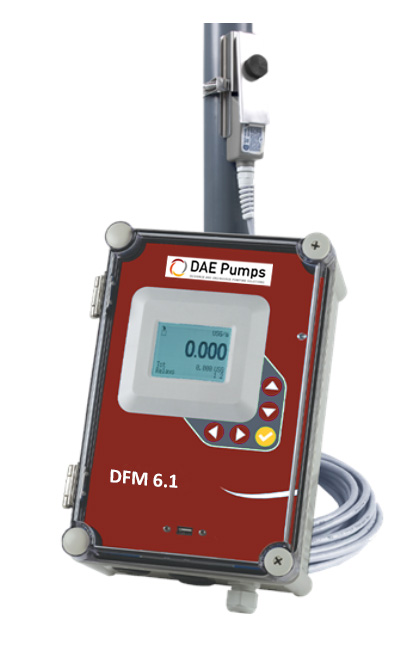
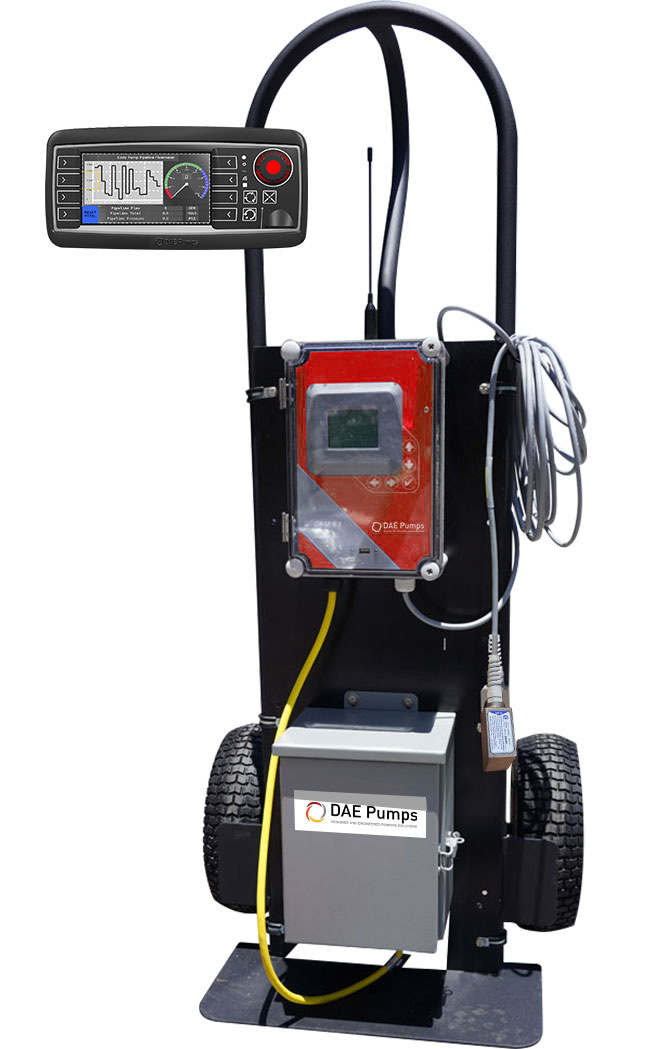
UFM1000 is a completely portable package for use in a remote location. This wireless flow meter system consists of the DFM 6.1 with transducer, reader, monitor, and battery pack on a dolly. The DAE Pumps UFM1000 doppler ultrasonic flow meter is housed in a NEMA 4X (IP-66) enclosure and is configured by the user via the front panel keypad. White, backlit matrix displays flow rate, relay states, 16-digit totalizer, operating mode, and calibration menu. Power supply options available to the DAE Pumps UFM1000 doppler ultrasonic flow meter include AC or DC s, and output options include 4-20mA, rate pulse, and dual relay.
The transducer is an SE4 single-head stainless steel ultrasonic with 7.6 m (25 ft) shielded cable and designed to withstand accidental submersion to 10 psi. The transducer is rated to NEMA 6P (IP-68) and can work with temperatures up to 300°F (150°C).
Get Pricing
Get Pricing on our Doppler Ultrasonic Flow Meters
Benefits:
-
Minimal installation time: the UFM1000 may be installed and fully operational within minutes. For most homogeneous pipe materials, there is no need to break into pipelines.
-
Minimal material costs: clamp-on sensor eliminates the need for in-line flanges, pipe fittings, strainers, or filters.
-
Reduced downtime: installation may be performed on full pipes and active systems. There is no need to shut down the process for installation or maintenance.
-
Lower maintenance costs: with no moving parts, there is nothing on the UFM1000 to wear down.
-
Proper operation: the presence of acoustic discontinuities, such as solid particles or air bubbles, is crucial for the proper operation of Doppler flow meters. Specific guidelines regarding the concentration and size of these discontinuities ensure effective signal reflection and accurate flow measurements.
-
Comparison with other meters: the UFM1000 excels in applications where other meters cannot function effectively, particularly in challenging conditions such as liquid slurries or liquids with suspended solids.

Features
-
Non-intrusive, clamp-on transducers for most pipes from ¼” (6 mm) and above
-
Wide measuring range: 0.15 to 30 FPS (0.05 to 9 MPS)
-
Microprocessor-based system; configuration and accumulation data stored in non-volatile flash ROM
-
Accuracy: ±2% full scale, over calibration span
-
Response Time: User selectable, 6-60 seconds
-
This unit connects wirelessly to the flow meter to pass data
-
Flowmeter data screen showing real-time flow rates
-
Sensors are integral to accurately measuring flow rates, water quality, and gas detection, ensuring operational efficiency and safety
-
Transmitter and receiver crystals play a crucial role in calculating flow rates by affecting the frequency shifts of sound waves emitted and received, essential for accurate flow measurements


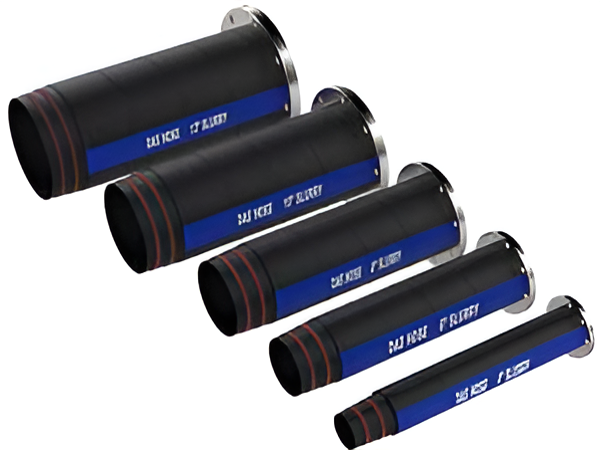
Slurry Hoses
The UFM1000 ultrasonic flow meter works ideally on the DAE Pumps slurry hoses for dredging and pumping. It is particularly effective in measuring flow rates in applications involving activated sludge. Slurry hoses provide the safe and efficient transferring of sludge, slurry, abrasive solids, and corrosive material, even when solid particles are present in the slurry, which can impact flow measurement. DAE Pumps slurry hoses are the best on the market at handling the most abrasive slurry. We offer 4-inch, 6-inch, 8-inch, 10-inch, and 12-inch hoses at lengths of up to 10 meters (33 feet).
UFM1000 Doppler Ultrasonic Flow Meters FAQs
What is an ultrasonic flow meter?
An ultrasonic flow meter is a device used to measure the flow rate of a fluid by sending an ultrasonic sound wave through the fluid and measuring the time it takes for the waves to travel between transducers. These meters are commonly used in various industries to accurately measure the flow of liquids, gases, and slurries. Transit time flow meters, in particular, excel in measuring flow for different types of liquids such as crude oils, cryogenic liquids, and molten metals, and are efficient in both clean and viscous fluid scenarios.
How does a Doppler flow meter differ from a traditional ultrasonic flow meter?
A Doppler flow meter is a type of ultrasonic flow meter that operates based on the Doppler effect, which measures the frequency shift of reflected ultrasonic waves to determine flow velocity. Unlike traditional ultrasonic flow meters, doppler and transit time flow meters operate on different principles. Transit time flow meters measure the time differential between upstream and downstream ultrasonic signals, which is essential for calculating the flow velocity as it varies when fluid is moving through the pipe. Doppler flow meters use an ultrasonic beam and are ideal for applications with suspended solids or bubbles in the fluid, such as slurries or wastewater.
What are the advantages of using a Doppler ultrasonic flow meter?
Doppler ultrasonic flow meters offer several advantages, including the ability to measure flow in fluids with high solids content or aeration, such as slurries or wastewater. Their measurement accuracy is significantly influenced by the presence of acoustic discontinuities, such as solid particles or bubbles in the liquid. They are also non-invasive and can be easily installed without disrupting the flow process, making them ideal for retrofitting existing systems or applications where access is limited. Proper signal reflection, which depends on the size and concentration of these discontinuities, is crucial for accurate flow measurements.
What industries commonly use Doppler ultrasonic flow meters?
Doppler ultrasonic flow meters are used in a wide range of industries, including mining, wastewater treatment, dredging, pulp and paper, and chemical processing. They are particularly effective for measuring the flow of crude oils, especially when conditions such as viscosity and flow type are taken into consideration. Their ability to accurately measure flow in challenging fluids such as slurries makes them indispensable for applications where traditional flow measurement technologies may be ineffective. Additionally, Doppler flow meters excel at measuring the flow of viscous liquids under certain conditions of flow characteristics, contrasting their performance with that of transit time flow meters.
How does a slurry flow meter differ from other types of ultrasonic flow meters?
A slurry flow meter is specifically designed to measure the flow rate of slurries, which are mixtures of solids and liquids. Doppler technology is particularly effective in these applications, as it measures the flow rate of liquids that contain suspended particulates or gas bubbles. Unlike traditional ultrasonic flow meters, slurry flow meters are optimized to account for the presence of solids in the fluid, ensuring accurate and reliable flow measurements in challenging environments. The Doppler effect occurs when sound waves reflect off moving particles in a fluid, leading to changes in wave frequency, which is critical for measuring fluid flow rates with Doppler flow meters.
What factors should be considered when selecting a slurry flow meter?
When selecting a slurry flow meter, it’s essential to consider factors such as the concentration and particle size distribution of solids in the slurry, the viscosity and density of the fluid, and the desired level of accuracy and reliability. The range of pipe sizes (0.25 to 120 inches) that the flow meter can accommodate is also crucial, as it ensures the device is suitable for the specific application. Additionally, factors such as installation requirements, maintenance considerations, and compatibility with existing systems should also be taken into account to ensure optimal performance and efficiency. The speed of sound in a fluid is influenced by both density and temperature, necessitating compensation for these factors to maintain accurate readings in varying flow conditions.
Contact Us Today
Please contact our sales team for product questions or if you need help selecting the best dredge or pump system for your application.
Phone: (760) 821-8112
Email: [email protected]
Live chat: Click to chat
Business Hours: 7:30a-5:30p Monday-Friday